The shoelace formula: the area of a polygon from its vertices
How the shoelace formula turns a list of corners into an area, why it works (trapezoids and cross products), what its sign tells you, and two traps: self-crossing rings and coordinates far from the origin.
Every time a GIS tool reports the area of a field, or OpenCV’s contourArea measures a blob, the same little formula is running underneath. Give it the corners of a polygon in order, and it gives you the exact area in one pass over the corners. No triangles to build, no grid. It also gives you a sign, which tells you whether the corners go clockwise or counter-clockwise. That sign turns out to be useful on its own.
The formula
Take a simple polygon (its border doesn’t cross itself) with vertices listed in order around the border. Treat the list as a loop, so vertex is vertex . Then
The name comes from doing it by hand. Write the coordinates in two columns, repeat the first vertex at the bottom, then multiply along the down-right diagonals () and the down-left diagonals (). The criss-crossing lines look like shoelaces. Subtract the second sum from the first and halve it.
Why it works: two pictures
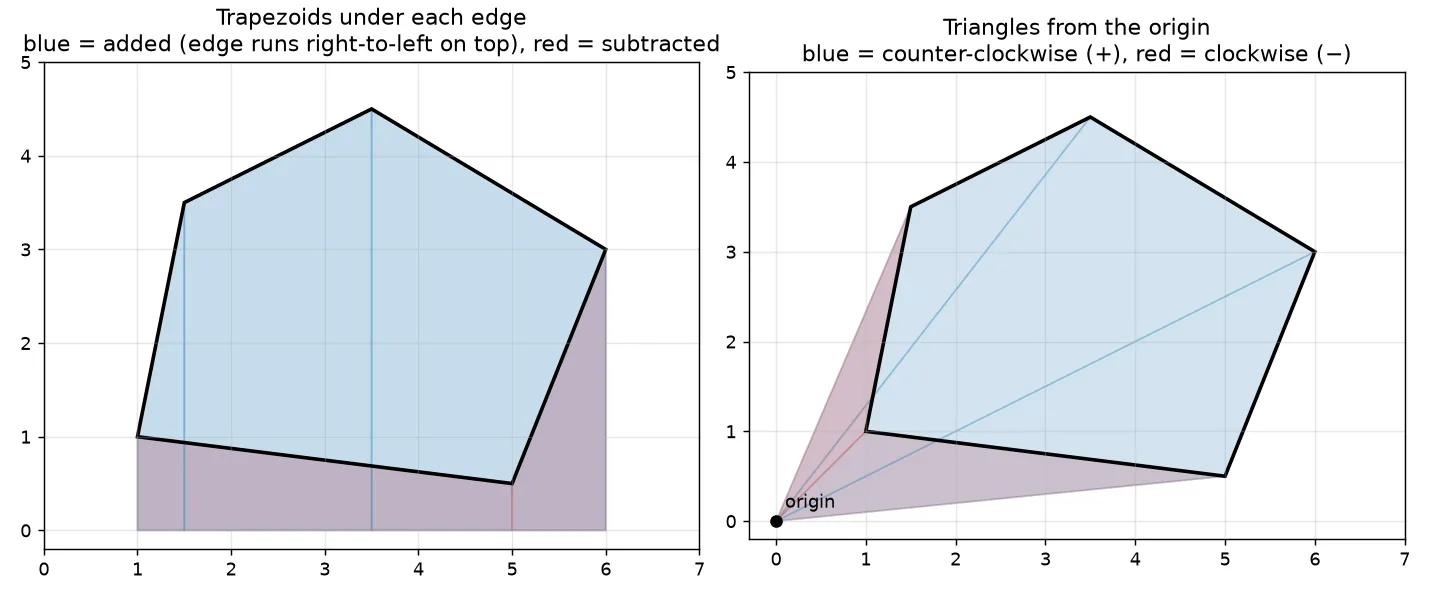
Trapezoids. Drop a vertical line from both ends of each edge down to the x-axis. Each edge then bounds a trapezoid with signed area . For a counter-clockwise polygon the top edges run right to left, so their trapezoids come out positive. The bottom edges run left to right, so theirs are negative. Add them up and what’s left is exactly the region between the top and bottom borders, which is the polygon. Expand the product, sum over all edges, and you get the formula above, because the terms cancel.
Triangles from the origin. This is the picture that made it click for me. The term is the 2D cross product of the vectors from the origin to vertex and to vertex . Half of it is the signed area of the triangle (origin, , ): positive when the triangle is swept counter-clockwise, negative when clockwise. The triangles that reach outside the polygon get counted once with each sign and cancel. Only the polygon’s own area is left. The origin can be any point, even one outside the polygon, and the answer is the same.
Both pictures are discrete versions of Green’s theorem, which says the area of a region equals the line integral around its border. On a straight edge, that integral is exactly .
Code
The vectorised version shifts the coordinate arrays by one place with np.roll, so vertex lines up with vertex and the wrap-around comes for free:
import numpy as np

def shoelace(xy, signed=False):
    """Area of a simple polygon from an (N, 2) array of vertices in order."""
    x, y = np.asarray(xy, dtype=float).T
    # x_i * y_{i+1} - x_{i+1} * y_i, with the last vertex wrapping to the first
    a = 0.5 * np.sum(x * np.roll(y, -1) - np.roll(x, -1) * y)
    return a if signed else abs(a)

square = [(0, 0), (1, 0), (1, 1), (0, 1)]
print(shoelace(square, signed=True))         # 1.0  (counter-clockwise)
print(shoelace(square[::-1], signed=True))   # -1.0 (clockwise)

l_shape = [(0, 0), (3, 0), (3, 1), (1, 1), (1, 3), (0, 3)]
print(shoelace(l_shape))                     # 5.0  (works for non-convex shapes)
The shape doesn’t have to be convex: the L-shape above has a dent and the answer is still exact. You also don’t need to repeat the first vertex at the end of the list. If you do, the extra term is , so nothing changes.
On a regular 500,000-gon inside a circle of radius 10, a plain Python loop and the NumPy version both give 314.15926535, close to (the polygon is a tiny bit smaller than the circle). On my laptop the NumPy version was about 35 times faster: 3.5 ms against 124 ms.
The sign is a free orientation test
Counter-clockwise order gives a positive signed area, and clockwise order gives a negative one (with the y-axis pointing up). This is how libraries check and fix the winding order:
- The GeoJSON standard (RFC 7946) asks for counter-clockwise outer rings and clockwise holes. Shapely’s
orient()and many GIS tools use the signed area to enforce this. - A polygon with holes has area . If the rings follow the convention, you can just add up the signed areas.
- In image coordinates the y-axis points down, so the visual direction flips: a ring that looks clockwise on screen has a positive signed area. This causes a lot of confusion when contours come from an image and later get drawn on a map.
Two traps
Self-crossing rings. The formula assumes a simple polygon. For a “bow tie” like , the two halves go in opposite directions and cancel, so the formula returns 0. In general it returns the sum of each region’s area times its winding number, which is rarely what you want. Check validity first and fix the shape if needed (see Polygons from detections: fixing invalid shapes).
Coordinates far from the origin. Each product can be huge while the difference between products is small. With 64-bit floats, that means you lose most of your precision when you subtract (catastrophic cancellation):
far = np.array(l_shape) + 1e8          # same L-shape, shifted far away
print(shoelace(far))                    # 8.0, wrong
print(shoelace(far - far.mean(axis=0))) # 5.0, right after centring
Projected map coordinates (UTM eastings and northings in the hundreds of thousands to millions of metres) are big enough for this to hurt on small polygons. The fix is cheap: subtract one vertex, or the mean, from all coordinates before using the formula. Moving a shape doesn’t change its area, and the products become small.
One more GIS catch: the formula works on a flat plane. Use it on raw longitude and latitude and you get “square degrees”, which don’t mean anything physically. Project to an equal-area or a suitable local projected coordinate system first, or use a geodesic area function for big regions.
More from the same sums
The same cross-product terms also give you the polygon’s centroid:
So one loop over the corners gives you area, orientation and centroid together, which is why this formula sits at the heart of most polygon libraries.
Key takeaways
- Area of a simple polygon , in one pass, convex or not.
- It’s a sum of signed trapezoids or signed triangles (Green’s theorem). The parts outside the polygon cancel.
- The sign gives the winding order: positive for counter-clockwise when y points up.
- Self-crossing rings give meaningless results, so check validity first.
- Centre the coordinates before computing, especially with big projected map coordinates, to avoid cancellation errors.
Resources
- Wikipedia, “Shoelace formula”: derivations via trapezoids, triangles and Green’s theorem. https://en.wikipedia.org/wiki/Shoelace_formula
- Joseph O’Rourke, Computational Geometry in C, 2nd ed., Chapter 1 (area of a polygon via triangles from a fixed point).
- H. Butler et al., RFC 7946, The GeoJSON Format, Section 3.1.6 (ring orientation). https://www.rfc-editor.org/rfc/rfc7946
- Shapely documentation:
Polygon.area,shapely.geometry.polygon.orient. https://shapely.readthedocs.io/ - OpenCV documentation:
contourArea(with theorientedflag). https://docs.opencv.org/